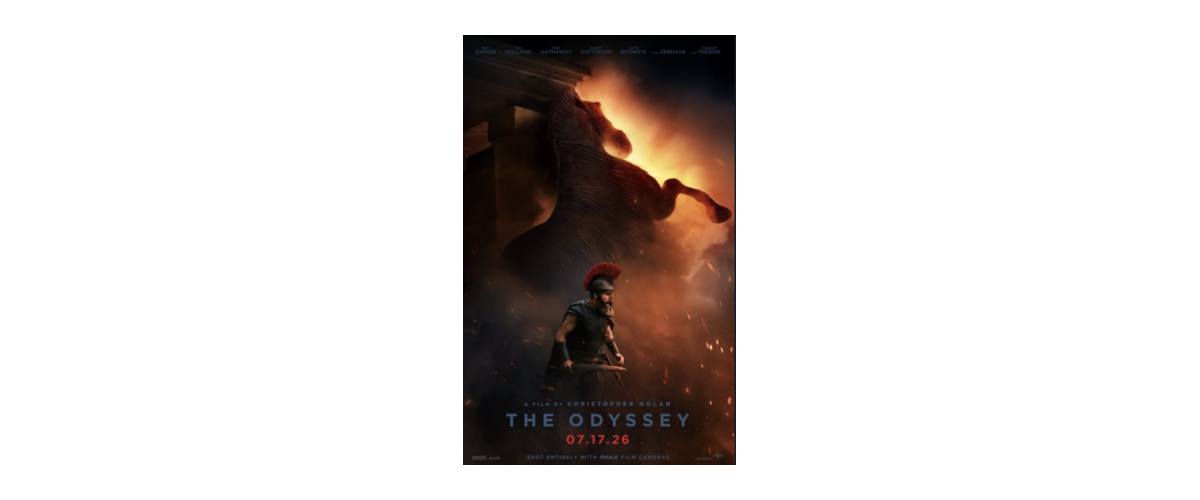
Heroic fantasy does not belong only to Robert E. Howard and Conan, nor to Tolkien and Middle-earth.
Long before them, Homer was already sending a cunning hero against monsters, gods, storms and supernatural creatures on an impossible journey. So yes: with The Odyssey, Christopher Nolan offers us his vision of fantasy… ancient fantasy.
An Odyssey Without IMAX
Yesterday, Ghorm’ak, my partner and I went to see The Odyssey at the cinema.
I should point out that we did not watch it in an IMAX theatre. Nolan obviously designed his film for the biggest screens imaginable, but that did not stop us from being completely swept away. The film’s power does not rest on its format alone: it also comes from its direction, its pace and the way it throws us out to sea alongside Odysseus.
Based on the writings attributed to Homer — a poet whose existence and biography remain surrounded by uncertainty — the film adapts a story almost three thousand years old.
And yet everything feels terribly familiar.
A tormented hero, an endless quest, companions put to the test, capricious gods and a bestiary worthy of today’s greatest fantasy works: The Odyssey could almost have come from an excellent Dungeons & Dragons campaign. Role-playing games have often drawn from ancient mythologies; Nolan reminds us just how much those stories already resembled the adventures we play around a table.
One inspiring the other…
Christopher Nolan, From The Prestige to The Odyssey
As usual, Christopher Nolan delivers.
I have to admit that I have followed his work closely since The Prestige, carried by the impeccable duo of Hugh Jackman and Christian Bale. Bale had already played Batman in Batman Begins and would later reunite with Nolan for the final two films in his Dark Knight trilogy.
For The Odyssey, Nolan also calls back two actors from Interstellar: Anne Hathaway and Matt Damon. This time they play Penelope and Odysseus, a couple whose love and separation form the true emotional heart of the story.
Tom Holland impresses as Telemachus. Robert Pattinson, meanwhile, continues to grow more powerful from film to film with his performance as Antinous. He moved beyond Twilight and his appearance in Harry Potter long ago, to the point that those roles which made him famous are now almost forgotten.
His talent is extraordinary, and his presence in Denis Villeneuve’s next Dune makes that film even more promising.
Lupita Nyong’o convinced me less in her dual role as Helen of Troy and Clytemnestra. Himesh Patel, on the other hand, is particularly convincing as Eurylochus.
Zendaya, Charlize Theron and the rest of this impressive ensemble complete a picture in which poor Matt Damon, as Odysseus, is given virtually no peace at all.
Christopher Nolan truly knows how to assemble a strong cast. He enjoys working again with some of his favourite actors, but he also knows how to welcome new faces into his universe. And, frankly, we want more.
A Deliberately Timeless Mythology
The film’s costumes and the ethnic backgrounds of some of its actors have attracted plenty of criticism.
But Nolan and his team deliberately chose not to make a straightforward historical reconstruction of ancient Greece. Their ambition was to create a timeless visual mythology without repeating every familiar cliché of the Hollywood sword-and-sandals epic.
And it works.
We are not watching a documentary about the Bronze Age. We are watching a legend that has been passed down, transformed and reinvented for almost three thousand years.
Mythology belongs to stories, and stories survive because every era makes them its own.
The Sea as a True Battlefield
In the visual effects and maritime sequences, you can feel everything Christopher Nolan learned while making Dunkirk.
The sailing is brutal, wet and almost physical. The ships do not seem to float in front of a green screen: they genuinely struggle against the sea. Every wave has weight, and every storm feels capable of swallowing both the actors and the cameras.
The greatest technical challenge was not necessarily the visual effects, but the use of new IMAX cameras capable of capturing both immense landscapes and more intimate scenes.
Even without seeing the film in IMAX, that pursuit of realism can be felt throughout.
Homer’s Cyclops and Monsters
I have not read Homer’s Odyssey, but from what I understand, the film follows its major stages while taking a few liberties and borrowing elements from other ancient stories.
My favourite passage remains the Cyclops sequence.
The creature is genuinely frightening, especially because its appearance remains almost human. For a few moments, it even becomes strangely sad after losing its sight.
In the end, is it not simply a living being that was quietly inhabiting its island before strangers invaded its territory?
I will stop with that episode, probably the most famous in Odysseus’s journey, so as not to spoil the film. Just know that the trials barely ever stop. For almost three hours, Nolan gives neither his characters nor the audience much time to breathe.
The ending is delicious and entirely worthy of his work.
My Film of the Year?
At this point, The Odyssey is my film of the year.
Unless Dune: Part Three manages to steal first place from it in December. Denis Villeneuve is one of my favourite directors, and Dune is, how should I put this… practically unbeatable for OrionOdin86.
Especially with Robert Pattinson joining that journey as well.
In the meantime, I am already eager to discover what Christopher Nolan has in store for us next. Nothing has been announced yet, but if his next project were truly to venture into horror, my answer would immediately be a resounding yes. 🙂
I will leave you with this English-language interview with Christopher Nolan by HugoDécrypte.
Official promotional poster for The Odyssey — © Universal Pictures / Syncopy. Reproduced in the context of this review.
Leave a Reply