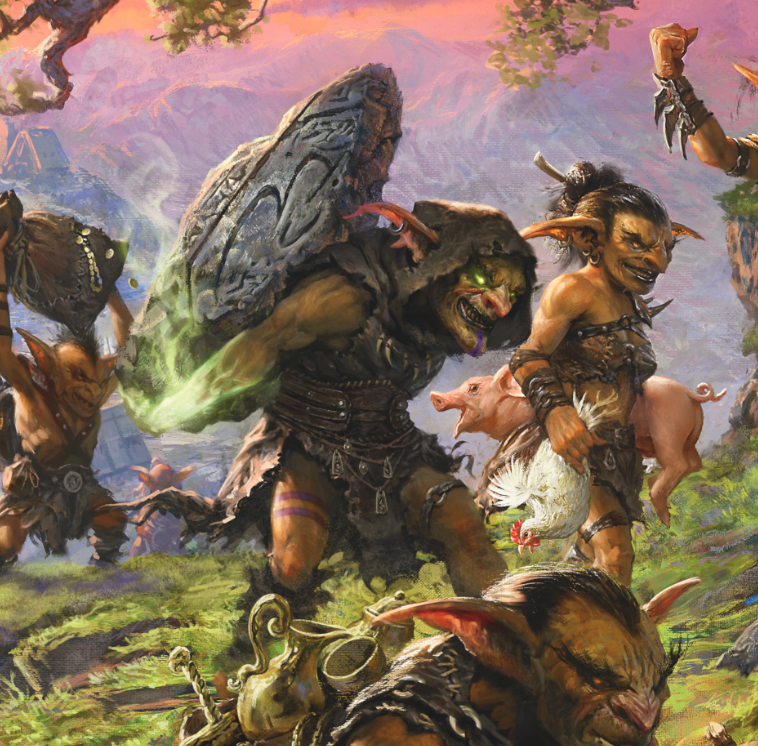
After more than fifteen years away from tabletop roleplaying, I ended up building my own group, stepping behind the Dungeon Master’s screen, and putting together a setup that combines books, digital tools, and 3D printing. To launch this new campaign, we set out for Phandalin—with goblins, traps, a megalomaniac bugbear, and several memorable inside jokes already waiting for us.
Warning: The first two parts of this article are about my return to tabletop roleplaying and my setup as a Dungeon Master. Part three contains major spoilers for Chapter 1 of Phandelver and Below: The Shattered Obelisk. A second warning will tell you exactly where to stop if you intend to play the campaign.
Part I — Returning to Tabletop Roleplaying After Fifteen Years
A decision made during recovery
During my recovery in 2025—because of my knee, always that knee—I decided, for reasons I can no longer entirely remember, to return to tabletop roleplaying after a break of more than fifteen years.
My previous attempt had been a Pathfinder campaign, although I ultimately took part in only two sessions. I really liked the game itself; the atmosphere around the table, considerably less so. I simply did not feel at home there. Not every group is the right fit, is it?
I did not know of any available groups, let alone a Dungeon Master ready to welcome us. So I chose the simplest solution—or the most unreasonable one, depending on your point of view: I would create my own table and become the DM myself. All I had to do now was set out in search of players.
To my great surprise, that quest proved much easier than expected. The seats filled quickly. Very quickly, in fact. We eventually formed a group that was more than full, with all the voices, ideas, playstyles… and joyful chaos that came with it.
From a homebrew campaign to Phandelver
For my first experience behind the screen, I chose Dungeons & Dragons and the revised 2024 rules, often nicknamed “5.5.” I also decided to write the story of our campaign myself. Ma poule—my regular digital copilot—helped me refine a few ideas and check the lore, because I wanted the world to remain as canonical as possible. That first homebrew adventure deserves an article of its own, though, and I will return to it soon.
After creating something so personal, I wanted to explore the other side of the DM’s role: bringing a major official campaign to life while still leaving enough room for our group and its characters to breathe. Phandelver and Below: The Shattered Obelisk ticked many of the right boxes: an instantly recognisable opening, characters starting at level 1, a long adventure in which they could grow, and—beneath its classic D&D flavour—the promise of far more unsettling mysteries.
And so we took the road to Phandalin.
Part II — Workshop: My Table Setup
You can play Dungeons & Dragons perfectly well with a few sheets of paper, some pencils, a set of dice, and a rulebook—perhaps hidden behind a DM screen. That simplicity is part of the beauty of the game.
I, however, wanted to take the experience quite a bit further.
D&D Beyond as mission control
As the Dungeon Master, I mainly use D&D Beyond to consult the rules. A digital search is so much faster than leafing through several books in the middle of a session. And when a rule remains stubbornly obscure, I can always ask ma poule for a second opinion.
That last option is not a luxury. Whether I read the French translation or the original English text, some wording remains surprisingly unclear. An interaction involving a bonus action, an opportunity attack, or two overlapping features can turn the whole table into a parliamentary inquiry.
D&D Beyond also lets me display maps on a second screen connected to my Mac. When the adventure includes an official map, I use it directly. For my homebrew material, I draw my own environments with Inkarnate, which I recommend for its ease of use, and then import them into the Maps tool.

A screen at the centre of the table
In the middle of the table, I place a portable Arzopa monitor on a stand that I printed in 3D. I also fitted it with a protective film to keep the display safe while we place and move miniatures across it.
For the price, the screen is genuinely excellent. Its only real drawback is that it is not touch-sensitive. I therefore control the map, movement, and fog of war from the Mac. In practice, this is hardly a problem: the image is clear, players can immediately see the areas they have explored, and removing the fog of war as they advance is remarkably easy.

Reference cards, because paper still has charm
For monsters, I recently bought the D&D Reference Cards: Ultimate Bundle. I could, of course, look up every stat block on a screen, but I really enjoy this combination of paper and digital tools. Pulling out a creature card, keeping it beside me, and checking its abilities at a glance is particularly satisfying.
That hybrid approach sums up my table rather well: digital tools make the game faster and smoother, while physical objects give the session texture and character.
Metal dice, an anniversary set, and a printed tower
For my rolls, I alternate between a set of metal dice I found on Amazon and the D&D 50th Anniversary: Modern Holmes Inspired dice set, bought from Black Book Éditions. I choose between them according to my mood—or the level of drama required by the scene.


Until now, I had been using a retro Dungeons & Dragons dice tray featuring artwork by Larry Elmore, also bought from Black Book Éditions, and I absolutely love it. Unfortunately, my natural talent for sending dice everywhere except where they are meant to land persuaded me to add a small dice tower I found on MakerWorld and printed at home.

The table also features several decorative prints and, most importantly, drawings made by my daughter. None of these little touches changes a single rule, but together they give our sessions an identity that truly belongs to us.
The decorations are, however, regularly invaded by a strange creature called Chips. We have yet to determine its challenge rating, but it seems particularly attracted to anything already occupying the table. ^^
Miniatures designed with Meshy and printed in filament
I use several approaches for miniatures, but most often I turn to Meshy. I can begin with an image selected by one of my friends or simply describe the character we want to create. The results are often very convincing, and the tool continues to improve at an impressive pace.
At this point, the main area for improvement is probably on my side: I still need to get better at placing supports so that I do not damage the pieces when removing them.
I initially printed characters at 32 mm scale. With a filament printer—I do not want to use resin at home for safety reasons—the results were already very respectable, but some parts remained fragile and the finished models could look genuinely tiny.
Because the map is displayed digitally, I can allow myself more freedom. I gradually moved towards miniatures of around 40 mm: they are sturdier, easier to read on the table, and much more satisfying to my eye.
I use a Bambu Lab X2D with 0.4 mm nozzles. A 0.2 mm nozzle would provide even finer detail, but I use the printer for many other projects and therefore do not change the setup every time. The photographs give a good idea of the final result once the figures are placed directly on the screen.


Part III — Campaign Report: Chapter 1
Major spoilers ahead!
From this point onwards, the article reveals the events of Chapter 1 of Phandelver and Below: The Shattered Obelisk, along with several important clues for the rest of the campaign. If you intend to experience it as a player, this is where you should stop reading.
A somewhat reshuffled party
Our ranger friend Ghor’mak decided to board a spelljammer and set off in search of other planes. Arnold the barbarian and Rankan the rogue, meanwhile, chose a different road to Phandalin.
That left our brave—and perfectly reasonable—company:
- Seigneur des Milles Prisons, an orc rogue;
- Waza, an elf wizard;
- Enariel, an elf cleric;
- Skarin, a human paladin.
The four of them set out for Phandalin to meet Gundren Rockseeker, a childhood friend of Seigneur des Milles Prisons. The dwarf had travelled ahead with Sildar Hallwinter.
Our heroes therefore left Neverwinter with an ox-drawn cart. Gundren had entrusted them with a shipment to deliver to the trading post in Phandalin. A simple, honest, paid assignment: there was absolutely no reason for anything to go wrong.
Four goblins and a very personal sense of priorities
Halfway there, the party discovered two horses lying in the road. Four goblins, hidden in the undergrowth, were preparing to pounce on our adventurers, but Waza spotted them in time and foiled their ambush.
The fight was brief but chaotic enough for one of the attackers to escape along a narrow trail. A closer inspection of the scene also revealed torn scraps of a shirt. They belonged to Sildar.
Every clue suggested that someone was in danger and that a fleeing goblin had just shown them which way to go. The decision seemed obvious.
Not to our chief paladin.
Skarin believed it would be wiser to finish delivering the cart and collect the reward before embarking on a rescue mission. Paladins these days—truly inspiring.
Fortunately, the unexpected sentimentality of Seigneur des Milles Prisons eventually prevailed. The group temporarily left the main road and followed the fugitive.
Eight kilometres of traps, webs, and bad ideas
The trail stretched for almost eight kilometres. Between concealed traps and a distinctly unwelcoming giant spider, the journey was not exactly a pleasant stroll.
The tracks eventually led the heroes to the mouth of a cave. On the other side of a stream about 60 centimetres deep, a band of goblins challenged them. For the adventurers, that depth was manageable. For the goblins, it seemed to represent an international border. Their leader therefore had to let his bow do the talking.
Seigneur des Milles Prisons quickly suffered the consequences and dropped to just 2 hit points. Skarin then made a poing d’honneur of healing him. Yes, poing—the French word for “fist”—rather than point. That wording is now officially canonical at our table.

Inside the Cragmaw hideout
The cave was completely dark. Fortunately for Skarin, his companions were thoughtful enough to light his lantern.
A stream about 60 centimetres deep also ran through the cave. The goblins had built a mechanism that could suddenly release the water stored further upstream. They triggered it only once, but that single cold and unexpected shower was more than enough to leave an impression.
The adventurers first discovered a chamber occupied by chained wolves, whose barking soon alerted the cave’s other inhabitants. They then climbed towards a larger room, where yet more goblins were waiting.
Then came Klarg.
The bugbear, self-proclaimed leader of the band, clearly believed himself king of the world and referred to himself in the third person. He posed a serious threat to level-1 characters… at least while he was awake. Enariel managed to put him to sleep, so Klarg spent nearly three quarters of the fight snoring while the party dealt with his minions. Once he awoke, his royal pretensions did not survive the party’s teamwork for long. Klarg therefore endured a very unpleasant fifteen minutes—most of them asleep—and our heroes left with his treasure.
Sildar, rescued in the nick of time
In a final chamber, the adventurers at last found Sildar. He was dying, at the mercy of a goblin boss and surrounded by several of its underlings.
It would take more than that to stop our valiant heroes. After one final battle, Sildar was rescued in the nick of time.
Admittedly… the DM may have been a little too kind on that occasion. Let us keep that between ourselves.

What Sildar revealed
Once he was safe, Sildar shared several crucial pieces of information with his rescuers:
- Iarno Albrek has disappeared. The human wizard was meant to be Sildar’s contact in Phandalin. He had been sent several months earlier to help restore order on behalf of the Lords’ Alliance, but no word has been heard from him. Sildar had come to investigate his disappearance.
- Wave Echo Cave has been found. Gundren and his two brothers, Tharden and Nundro Rockseeker, recently discovered the entrance to this long-lost mine, once worked under the Phandelver Pact.
- A mysterious Spider is pulling the strings. Klarg had been ordered to attack and capture Gundren. From what Sildar overheard, those instructions came from a person or creature known as “the Spider.” He still has no idea who—or what—lies behind the name.
- Gundren and his map were taken away. The dwarf carried a map revealing the secret location of Wave Echo Cave. The goblins stole it before sending both prisoner and document to Cragmaw Castle. Sildar does not know where the fortress stands, but someone in Phandalin may be able to point them in the right direction.
- A very strange goblin accompanied the attackers. Its unnaturally elongated head deeply unsettled Sildar. Even the Cragmaw goblins did not seem to know it. Before leaving, the creature apparently whispered: “You’re not what Ruxithid is looking for.”
Sildar now wants to reach Phandalin as quickly as possible. He offers the group 50 gold pieces to escort him there. He currently has no money, weapons, or armour—his equipment was sent to Cragmaw Castle—but says he can obtain the promised sum within a day of their arrival. He also hopes his rescuers will put a definitive end to the goblin raids by securing their hideout.
In other words, the journey has only just begun.
The DM’s Debrief: Flops and Highlights
The first evening was a genuine success, but it also helped us identify several things to improve before the next session.
The flops
- The initiative tracker: too small, with markers that refuse to stay in place. I will need to redesign it or print a new one.
- The finishing time: ending at around 2 a.m. hurts when the children wake up early—and even more so for those who still have over an hour’s drive home.
- The missing wolves: I had forgotten where I put the miniatures printed for the encounter. They were hastily replaced by tarantulas. Nobody was fooled, but everyone survived this zoological offence.
- Some miniatures were too small: 32 mm shows its limitations in filament printing. Moving gradually to 40 mm should solve much of the problem.
- Rules that are not always clear: even with the books, D&D Beyond, and several brains around the table, some interactions remain laborious to interpret.
- The D&D Beyond player app: less clear and less fluid than we had hoped.
- Ghor’mak’s departure: his ranger has left for other planes, but his absence will inevitably leave an empty place at the table.

The highlights
- The good mood, from beginning to end.
- The group’s cohesion and mutual support, both during decisions and in combat.
- An ideal opening scenario, immediately accessible but already rich in clues for what comes next.
- The central screen and maps, which make encounters very easy to read.
- The miniatures and equipment in general, which give the adventure a tangible presence.
- The DM web interface, very useful for keeping maps, rules, and information together.
- The fog of war, simple and quick to manage during exploration.
- The uncontrollable laughter, already plentiful enough to produce several inside jokes. Chief among them is the famous poing d’honneur—because, after all, un poing, c’est tout.
Onwards to Phandalin
This first chapter fulfilled its role perfectly. The characters were well balanced, the group wanted to move forward together, and the story immediately gave us several reasons to continue: find Gundren, locate Cragmaw Castle, uncover what happened to Iarno Albrek, and—above all—discover who or what hides behind the Spider and the name Ruxithid.
But the most important thing lies elsewhere.
Thank you, guys. You are fantastic. If this table lets us laugh, escape from everyday life, and share adventures like these, it is first and foremost thanks to you. Un poing, c’est tout.

Leave a Reply