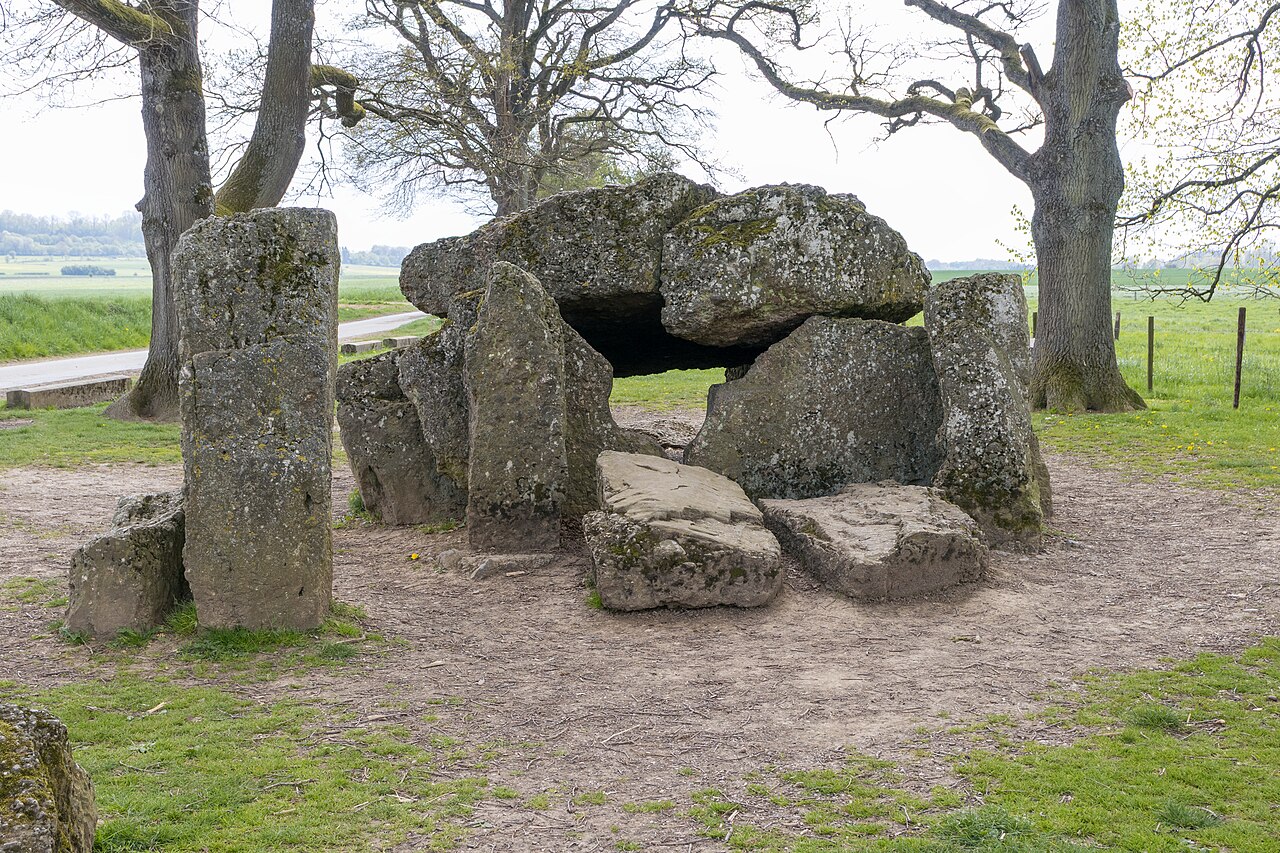
Beneath the dolmens of Wéris, in the caves of the nutons, beside waters haunted by Marie Crochet and in the glow of the Grands Feux, Wallonia possesses an extraordinarily rich imaginary world. Yet these stories do not all have the same age or the same degree of certainty. Let us explore this folklore without turning hypotheses into facts—because the real stories are fascinating enough.
The idea for this article did not come to me in Wallonia, but in northern Iceland, during our holiday around Akureyri. While talking with our Icelandic hosts and friends, one of our hosts spoke quite naturally about the Hidden People, the huldufólk. I promised her that, once back in Belgium, I would look into our own hidden beings and write an article about them. The conversation stayed with me, as did the promise.
Back home, one question insisted on being asked: what beings have we placed in our rocks, caves, forests and nights? This modest piece of work therefore fulfils a promise. It is also my way of paying tribute to our Icelandic friends and, through them, to the Icelandic people, heirs to the generations of women and men who shaped and passed on the legends of their island.
I am not claiming that the Icelandic huldufólk and the Walloon nutons are two names for the same hidden people, or that they share a demonstrable historical origin. A conversation in Iceland simply made me want to listen more closely to the voices from home.
Sometimes all it takes is to look at Wallonia through a dungeon master’s eyes. A cave becomes the entrance to an underground workshop. A light in a marsh tries to lead travellers astray. A ruined castle conceals a golden goat. An invisible hunt races through the night, escorted by supernatural hounds.
It would be tempting to gather all this into one great “Walloon mythology”, complete with a pantheon, monsters and a continuous story reaching back to prehistory. That would be appealing. It would also be misleading.
Walloon folklore becomes more interesting when we accept its seams: Neolithic monuments whose function is studied by archaeologists; a few divine names preserved in ancient inscriptions; stories recorded on a particular date in a particular village; legends reshaped by writers; and festivals created or reinvented in modern times. These layers meet, but they are not interchangeable.
Here, then, is a very personal—and as rigorous as possible—journey among the nutons, macralles, loumrotes, revenants and great figures of Wallonia’s folklore.
A legend is not an archive: the rule of the journey
Before crossing the first threshold, we need one simple rule: saying that a story was collected is not the same as saying that the events in it actually happened. It means that, at a given place and time, people knew, told or recognised that story.
This article distinguishes four levels:
| Level | What we may claim | Example |
|---|---|---|
| Archaeology or historical document | An object, building, inscription or court record exists and can be dated | The Wéris megaliths; a dedication to Ardbinna; trial records |
| Collected tradition | A researcher recorded that a story, word or custom circulated in a given place and period | The nineteenth-century account of the supernatural hunt at Bohan |
| Legend or literary reworking | A story is attested in a book, work of literature or local tradition, without proof of an ancient oral origin | Some fairy tales popularised by regionalist writers |
| Living tradition or modern creation | A community keeps a ritual or performance alive today, sometimes one of recent origin | The Sabbat des Macralles in Vielsalm, founded in 1955 |
This caution takes nothing away from the magic. On the contrary, it helps us understand how stories are transmitted, moved and transformed.
Walloon folklore is not a single mythology
The word folklore covers far more than supernatural creatures. In his 1892 book Le Folklore wallon, Eugène Monseur brings together beliefs, tales, songs, riddles, children’s games, remedies, calendar customs, proverbs and supernatural narratives. His work is especially valuable because he also explains his method and the limits of his collection: questionnaires, local correspondents, incomplete material and the need not to reconnect fragments that were no longer connected in the tradition itself.
That warning remains remarkably modern. A motif resembling a Germanic, Celtic or Christian story is not automatically its direct descendant. The resemblance opens a path for comparison; it does not prove a genealogy.
Folklorists Roger Pinon and Françoise Lempereur likewise emphasise the scope of this traditional literature: songs, rhymes, riddles, proverbs, tales, legends, popular theatre and almanacs. They also show how much repertoires differ by place and regional language. Speaking of “Walloon” folklore in the geographical sense must not erase the diversity of the Walloon-, Picard-, Gaumais-, Champenois- and German-speaking areas that make up present-day Wallonia.
We are not looking at a lost sacred book whose chapters must be reconstructed. We are looking at a constellation of local practices and stories.
Eugène Monseur, the man who wanted to save Walloon voices
Eugène Monseur (Liège, 1860–Brussels, 1912) did not approach folklore as though it were a minor cabinet of curiosities. He earned a doctorate in philosophy and letters from the University of Liège in 1884 and a doctorate in law in 1885, trained in Sanskrit, studied in Paris and Berlin, and taught at the Université libre de Bruxelles from 1888. According to his biographical notice from the Public Service of Wallonia, it was precisely his interest in the history of religions and Indo-European origins that convinced him of the urgency of preserving the beliefs, words and traditions of the Walloon people.
In December 1889, together with Maurice Wilmotte and Auguste Stécher, he was among the principal founders of the Société du Folklore wallon. In 1891 he published a questionnaire that was sent to local correspondents; the replies formed the basis of Le Folklore wallon the following year. The book is therefore not a mythology written in one sweep. It is an attempt to organise scattered material while stating where it came from and, often, what remained unknown.
I greatly appreciate Monseur’s work. Not because every one of his interpretations has become definitive—his book also bears the scholarly categories and vocabulary of 1892—but because he preserves local names, cites informants and readings, compares without always conflating, and acknowledges the gaps in his inquiry. He does not give us perfectly smooth folklore; he lets us hear something of its actual voices. His commitment extended beyond popular traditions: the same notice recalls the important role he played in the birth of the Belgian League for Human Rights.
Wéris: Neolithic megaliths, not Celtic monuments
Let us begin well before the written legends. At Wéris, near Durbuy, dolmens and menhirs form one of Belgium’s most remarkable megalithic complexes. The Maison des Mégalithes attributes them to Neolithic farming and herding communities roughly five thousand years ago. The Most Beautiful Villages of Wallonia places their construction around 3000–2800 BCE and recalls the funerary purpose of the dolmens.


Here we encounter a first chronological trap: the megaliths of Wéris are not Celtic monuments. They long predate the societies usually described as Celtic in this region. Nor is there evidence of an unbroken line between the people who placed their dead there during the Neolithic and the tales told in Walloon villages in the nineteenth century.
That did not stop the stones from attracting legendary explanations later on. When a landscape preserves monuments whose original purpose is no longer understood, imagination readily supplies new builders: giants, devils, fairies or saints. Archaeology tells us about the monument; legend tells us about the later communities that looked upon it.
Let us now leave the megaliths but remain in the Ardennes. Wéris is not what leads us to Arduinna; the name “Ardennes” itself does. In Book V of The Gallic War, Caesar already calls the vast forest of this region Arduenna silva. A very similar name is also associated in antiquity with a deity called Ardbinna or Arduinna. It is this resemblance between the names—not a connection with the dolmens—that warrants the following detour.
Arduinna and the Ardennes: an ancient name, and a great deal of caution
Let us state the limit immediately: nothing connects the Neolithic builders of the Wéris megaliths to this ancient goddess. Nearly three millennia separate them, and the nature of our sources changes completely: Wéris belongs first to prehistoric archaeology; Arduinna to a Gallo-Roman inscription and to later scholarly interpretations.
The precise linguistic relationship between the name of the territory and that of the deity—and what it may reveal about her functions—remains debated. Their proximity nevertheless helps explain why Arduinna has acquired such importance in the modern Ardennes imagination. Her case neatly sums up both the pleasures and dangers of mythological reconstruction.
A divine name is securely attested in antiquity, but the evidence is extremely thin. A Latin dedication found near Düren, in present-day Germany, reads Deae Ardbinnae, “to the goddess Ardbinna” (CIL XIII, 7848). A second inscription has sometimes been linked to the same deity, but its fragmentary state prevents a certain identification. Noémie Beck’s dissertation on Celtic goddesses examines precisely the inscriptions and iconography attributed to Arduinna. A specialist survey by Nico Biermanns also gathers the evidence and scholarly debates.
The famous statuette of a woman riding a boar, however, bears no inscription identifying her. Its association with Arduinna comes from a later scholarly interpretation and is not an archaeological certainty. Nor do we possess an ancient cycle of stories detailing her birth, adventures or character.
The most honest formulation is therefore this: the divine name is attested; the image of the “Ardennes goddess riding a boar” is a disputed identification; and the extensive story now built around her is largely modern. Arduinna remains no less interesting. She shows how a minute body of ancient evidence can nourish an immense regional imaginary—provided we mark clearly where proof ends and reconstruction begins.
Nutons, sotês and other workers of the night
If one family of beings is deeply rooted in Walloon stories, it is surely that of the little inhabitants of caves and underground places.
In his overview of supernatural beings in Walloon folklore, Jean Fraikin describes nutons as small beings, often aged in appearance, who live in caves or underground. They emerge at night and excel at manual work. Shoes, tools or linen are left near their dwelling, together with food as payment; by morning the task has been completed. They may be helpful, but anyone who deceives or insults them risks their revenge.
The name changes from place to place. Forms include nuton, sotê, messotê and luton, with local distributions that dialectologist Jean Haust already attempted to map. These variants matter: they keep us from turning neighbouring traditions into one perfectly uniform supernatural species.
Nutons bring together several striking themes: exchange with the invisible, the value of labour, the duty to pay fairly and the danger of breaking an unspoken rule. They are not merely “Walloon fantasy dwarves”. Their role is defined above all by the relationship humans maintain with them.
Fraikin also distinguishes nutons from fairies, even if stories sometimes bleed into one another. Fairy traditions are especially prominent in the Semois valley and Gaume. But he gives a crucial warning: some stories attributed to the Meuse, Ourthe or Amblève valleys were embellished, or even invented, by nineteenth-century regionalist writers. A beautiful story published by Marcellin Lagarde or another author may belong to Wallonia’s literary heritage without being a faithful transcription of an old oral belief.
In other words, we must ask not only “does this story exist?” but also “in what form, since when, and through whom did it reach us?”
After midnight: water bogeys and the supernatural hunt
The stories collected by Monseur reveal a Walloon night teeming with inhabitants. They also show just how local their names are.
Keep away from the water
At Saint-Hubert, children were frightened with Marie Crochet, said to haunt places near water. At Huy, the threat became a “hook man”. At Souverain-Wandre, a red-toothed man threatened to lure children into the Meuse. These figures serve a very practical purpose: they give a terrifying face to the danger of rivers, wells and ponds. They belong to the broad family of bogeys, but their geography and details are not interchangeable.
It is tempting to look behind every such figure for a pre-Christian water deity. The sources generally do not allow us to go that far. What Monseur’s complete text does establish is that these names and threats had been reported to collectors in the late nineteenth century.
Two nocturnal hunts that should not be confused
Under the heading “The Wild Huntsman (li sâvatch tchèsseu)”, Monseur actually places two separate notices. The first is set at Bohan, on the Semois, in the former forest of La Fargne. People spoke of an old lord who had been embroiled in a lawsuit with the inhabitants over communal woods and who, in expiation for his depredations, returned to hunt after death.
The story follows a man from Sugny who, after boasting at an inn in Bohan, crosses the forest at about eleven at night. First he hears a horn, then the dogs. Terrified, he lies face down and sees hundreds of hounds pass by, followed by hunters on horses whose nostrils spit flames. Among them rides the lord of Bohan, his face like a corpse and fire burning in his eye sockets. The man returns sick with fear; when he finally recovers, his hair is said to have turned white.
Here the chain of transmission is unusually clear. Monseur states that he summarises and abridges the story published by Jérôme Pimpurniaux in volume II of the Guide du voyageur en Ardenne (1858). His notice refers to pages 229–234, while the infernal hunt itself occupies pages 231–234. We therefore have a printed text from 1858, reused and condensed by Monseur in 1892—not the direct testimony of a witness interviewed by us today.
The second notice is much shorter. At Grivegnée, roughly forty years before Monseur’s collection, people were said to believe in the appearance of a supernatural huntsman galloping past with two dogs whom he called very distinctly Tah and Pouha. The motifs are clearly related, but that does not entitle us to merge the two accounts into a single legend.
Such cavalcades are often compared with the “Wild Hunt” known across many parts of Europe. The comparison is useful. To claim that the Walloon story directly preserves a specific myth—Odin’s, for example—would nevertheless require a chain of transmission that we do not possess. Once again, resemblance is not a birth certificate.
Loumrotes, little white women and revenants
The loumrote—loumrot’ in Monseur’s spelling—is a small wandering light reported in the province of Liège. It draws travellers towards a pond or dangerous ground. In the Herve region, some women were said to ward it off by wearing their stockings or skirt inside out. The familiar European will-o’-the-wisp motif is recognisable, but the name and protective gestures are local.
Nor does the colour white identify a single creature. At Mazy, three lanterns carved from roots to frighten passers-by were called “the three white women”. In the Liège region, the little white woman—li ptit’ blank fœm, in the spelling published by Monseur—might sit on a doorstep and announce an approaching death. Other Walloon stories mention white ladies bound to particular places, but merging them into a single “White Lady of Wallonia” would erase precisely what is local about folklore.
The revenants recorded in the nineteenth century often appear dressed in white, sometimes drag chains and return because an obligation remains unfinished: a prayer, a Mass, a debt or an injustice to be put right. A ghost does not always appear at random. Its return signals that a moral or social order has been broken.
The golden goat: the treasure that refuses to be taken
In his section on “Treasures”, Monseur devotes three notices to the motif of the golden goat, or gat’ d’ôr. At the bottom of a ruined castle’s underground passage lies an iron chest guarded by a goat with golden horns. The animal is often understood as the revenant of a former inhabitant—an unfaithful steward, miserly chatelaine or another guilty person condemned to guard the wealth after death.
At Franchimont, the guardian becomes a billy goat called vèrbo, described as a demon lying on the chest. It would leave its post for only one hour on certain days of the year: the sole moment when the treasure could be taken. Another rule that appears almost everywhere in Monseur’s notices is that the chest must be brought into the light without a word being spoken. One triumphant exclamation from a treasure hunter is enough to send it crashing back into the abyss.
The Logne version has its own story. The Domaine de Palogne reproduces a legend recorded in 1839 by Dr Jean-Pierre-Paul Bovy in his Promenades historiques dans le Pays de Liège. Marthe, a young woman seduced by gold, is found dead in an underground passage, laden with golden chains. Thereafter, a goat gleaming with her jewels is said to appear in the passage, especially on the eve of great religious feasts; whoever catches it will force the animal to reveal the treasure’s hiding place. If you would rather listen than read, this short story of the golden goat is also available in the RTBF programme Un Jour dans l’Histoire on Auvio.
It is therefore better to speak of golden goats and their variants than of one perfectly uniform Walloon story. We may read the motif as a test of greed and human speech; that interpretation is ours, while the motifs, places and characters belong to the cited texts.
Werewolves, chain-dogs and the nightmare on your chest
The werewolf also changes name and sometimes shape. Monseur records leu warou in the Liège region and dyâl lèwèrou around Herve. Near Charleroi we find a comparable being in the form of a dog dragging a chain. Witchcraft stories likewise include transformations into a cat, dog, wolf, goat, hare, toad or bull. A recurring motif has the wound inflicted on the animal reappearing on the human body of the alleged witch or sorcerer.
The nightmare itself becomes a presence. Under names such as tchókmark, tchódmark or simply mark, a spirit presses down on the sleeper. A modern reader will immediately think of sleep paralysis, an experience that can involve immobility and a crushing sensation. That comparison may help us understand how a story takes shape; it cannot retrospectively diagnose every old account.
This bestiary tells us more than what people feared. It shows how a sensation, accident, illness or transgression could become tellable once it received a name and a form.
Macralles: do not confuse persecution with festivity
Today the word macrale evokes a Walloon witch, often mocking, carnivalesque and proudly local. Yet two very different histories lie behind this figure.
The first is tragic. Witch trials belong to European legal history, with an especially deadly phase from the second half of the sixteenth century into the early seventeenth. The scholarly exhibition Présumées coupables recalls the effects of crises, stereotypes targeting women, leading interrogations and torture. The State Archives in Belgium preserve case files that reveal how accusations operated within the courts.
At Ellezelles, Quintine de la Glisserie and four other women were sentenced on 26 October 1610. This historical episode now feeds a festival, but the festival itself does not date from the seventeenth century: the Sabbat des Sorcières d’Ellezelles was launched in 1972 by the artist Jacques Vandewattyne. Held on the last Saturday in June, it combines performance, supernatural characters, local speech and satire of current affairs.
The second history is that of spectacular folklore consciously constructed by a community. At Vielsalm, the Macralles society was founded in 1955, with its first public scenes following in 1956. The Sabbat des Macralles, performed in Walloon around 20 July, reviews the year’s local events and foibles. Its figures include Gustine Maka, the young loumerotes—apprentice witches—and the Neûr Bo, a black-goat figure associated with the devil. The Vielsalm tourist office and the Public Service of Wallonia clearly document this chronology.
Saying that a tradition began in 1955 or 1972 does not make it “fake”. A living tradition need not disguise itself as a medieval survival in order to have value. The festive macrale must not, however, make us forget the real people who were interrogated, tortured or sentenced in the past. The stage witch and the historical accused are not the same figure.
When the landscape tells stories: Devil’s stones, nail trees and springs
Walloon folklore readily attaches itself to the terrain. Near Stavelot, a legend reported by Monseur explains a huge boulder through a trick played by Saint Remacle. Warned that the devil is bringing the stone to crush the abbey, the saint sends him a monk carrying a basket of old sandals. The monk claims that they were new when he set out; believing the town still impossibly far away, the devil gives up and drops his burden. The landscape thus preserves the narrative evidence of their encounter. Such a story Christianises the landscape without allowing us to date either its obviously much older geology or the exact origin of the tale.
Nail trees present an even more delicate case. The general principle is to bring an illness symbolically into contact with a tree: a nail, sometimes rubbed against the painful part of the body or associated with a piece of cloth, is driven into the trunk so that the ailment may be transferred to it. The entry in the Living Heritage Inventory of the Wallonia-Brussels Federation describes a practice that has become very rare and is mainly associated with lime trees and oaks.


This passage takes me back to a very personal memory. As a child, on a school trip to a village in the Ardennes, I saw a tree into which coffin nails had been driven. We were told that the nails were used to relieve toothache: the pain was symbolically entrusted to the tree. The image has stayed with me, although I can no longer identify the village with certainty.
That memory does not prove that the rite was still being practised when we visited; it records what was explained to us. The association between toothache, a coffin nail and a tree is, however, well documented. The same heritage entry quotes a text by Jean Chalon published in 1912: the nail had to touch the aching tooth and then be driven silently into the north face of an oak. The childhood memory and the written source echo one another without needing to be confused.
The same entry also adds an essential qualification: the coexistence of a tree and a chapel does not automatically prove that the Church took over an older “pagan” cult, and nothing requires us to date the nailing practice to pre-Christian times.
Fieldwork by Françoise Lempereur offers another perspective. In her study of healers and therapeutic pilgrimages in Wallonia, she reports that a 2003 survey in the provinces of Liège and Luxembourg could not confirm the effective survival of therapeutic nail-tree rites, despite a few apparently recent nails. Springs and fountains reputed to be miraculous appeared to attract more visitors.
These findings do not cancel one another out. They show why the practice must be dated and located instead of being described as something that “has always existed”. A heritage inventory records a tradition and its memory; fieldwork asks who still practises it and can testify to doing so.
The Grands Feux: burning winter without inventing an origin
At the end of winter, several Walloon communities light a communal bonfire. The Public Service of Wallonia describes the Grands Feux—literally “Great Fires”—as a passage from darkness to light, associated with purification, protection and sometimes the burning of an effigy of winter. They are often held on the first Sunday of Lent.
Names differ by region: Grand Feu or Feûreû in several Walloon-speaking areas, écouvillage or adrèche in Picard-speaking regions, bûle in Gaume and boûre in the Champenois-speaking area. This linguistic geography reminds us once again that a shared custom does not everywhere have the same vocabulary or exactly the same form.
Seasonal symbolism often leads people to label these fires “Celtic” or “pagan”. That may serve as a very broad comparative hypothesis; it has not been demonstrated for each local festival. The better question is not so much “which ancient rite survived intact?” as “how does this community explain and organise its fire today?”
Folklore that still marches, dances and fights
Folklore is not preserved in books alone. It fills the streets, mobilises associations and sometimes involves entire towns.
The Marches of Entre-Sambre-et-Meuse, inscribed by UNESCO on the Representative List of the Intangible Cultural Heritage of Humanity, accompany processions dedicated to a saint or parish with companies organised on a military model. Their significance lies as much in collective participation and transmission within families and local societies as in the parade itself.
The Carnival of Binche, also recognised by UNESCO, unfolds over the three days before Lent through a complex set of preparations, costumes, music and shared rules. Reducing the Gilles to a photogenic silhouette would miss the point: the ritual exists because an entire community knows its rhythms and codes.
At Mons, the battle known as the Lumeçon forms part of the ritual Ducasse and of the wider group of processional giants and dragons in Belgium and France. At Namur, the stilt jousts, featuring the Mélans and Avresses, joined the Representative List in 2021. And in Liège, Tchantchès turns rod-puppet theatre into a popular chronicle, mixing heroic cycles with urban irreverence.
In Ath, the great annual gathering is not called a carnival but a Ducasse. The Ducasse of Ath brings a procession of giants, decorated floats and historical groups to life over several days around Goliath, known as Gouyasse in local speech. Like the other festivals mentioned here, it exists first and foremost through the residents, bearers, musicians and families who prepare it and pass it on.
What these stories really tell us
What remains once we give up overly perfect genealogies? An enormous amount.
Nutons speak of work, reciprocity and the cost of a promise. Marie Crochet gives a face to the danger of water. The loumrote turns a marsh into an intentional trap. A revenant returns because a debt remains unpaid. The golden goat tests greed. The nightmare personifies nocturnal oppression. The contemporary macrale turns fear into satire, while also forcing us to look at the history of persecution. The Grands Feux stage a community’s passage from one season to another.
Folklore is not a bad textbook of supernatural zoology. It is a way of making the world habitable: naming its dangers, establishing its rules, transmitting memories and laughing at what frightens us.
Four questions are often enough to explore a tradition without inventing a pedigree for it:
- Who reports the story? A witness, folklorist, writer, tourist office or association?
- When was it recorded? A nineteenth-century publication proves at least that it circulated or appeared in print then—not necessarily that it dates back to antiquity.
- Where is it located? A name or motif collected in Herve does not automatically apply to the whole of Wallonia.
- What is its status? Archaeological object, court archive, oral narrative, literary creation, modern festival or contemporary reinterpretation?
This is the method I like best. It does not “debunk” an enchanted Wallonia; it restores its actual voices. They are more numerous, more local and often stranger than the uniform mythology we might be tempted to invent in their place.
So the next time a light moves beside a path, the wind seems to carry invisible hounds, or a stone looks far too large to have been placed there by human hands, let someone tell you the story. Then simply ask who told it before them.
Sources cited in this article
Collections and studies of folklore
- Eugène Monseur, Le Folklore wallon (1892)—contents and text
- Eugène Monseur, “Êtres merveilleux”—supernatural huntsmen, revenants, treasures and nutons
- Public Service of Wallonia, biographical notice on Eugène Monseur
- Jérôme Pimpurniaux, Guide du voyageur en Ardenne, vol. II (1858), pp. 231–234 for the infernal hunt of Bohan
- Jean Fraikin, “Les êtres fantastiques du folklore wallon”
- Roger Pinon and Françoise Lempereur, “La littérature traditionnelle”
- Public Service of Wallonia, “Folklore et tradition” portal
- Inventory of intangible cultural heritage in the Wallonia-Brussels Federation
- Domaine de Palogne, “Légende de la Gatte d’or de Logne”, after Jean-Pierre-Paul Bovy (1839)
- RTBF Auvio, Un Jour dans l’Histoire—the short history of the golden goat in audio
Prehistory and antiquity
- Maison des Mégalithes de Wéris
- Wéris and its megalithic field—Most Beautiful Villages of Wallonia
- Julius Caesar, The Gallic War, Book V—Latin text and French translation from the Bibliotheca Classica Selecta
- Noémie Beck, Goddesses in Celtic Religion—Cult and Mythology (dissertation, 2009)
- Bibliographic record for Noémie Beck’s dissertation
- Nico Biermanns, study of the evidence concerning Dea Arduinna
Witchcraft, macralles and healing practices
- Criminocorpus, “La sorcière” in the Présumées coupables exhibition
- State Archives in Belgium, trial files and witchcraft cases
- Public Service of Wallonia, Sabbat des Sorcières d’Ellezelles
- Living Heritage, Sabbat des Macralles du Val de Salm
- Vielsalm tourist office, the Macralles
- Public Service of Wallonia, the Macralles du Val de Salm
- Living Heritage, nail-tree practice
- Françoise Lempereur, study of healers and therapeutic pilgrimages in Wallonia
Living traditions
- Public Service of Wallonia, the Grands Feux
- UNESCO, Marches of Entre-Sambre-et-Meuse
- UNESCO, Carnival of Binche
- UNESCO, processional giants and dragons in Belgium and France
- UNESCO, stilt jousting in Namur
- Ath tourist office, introduction to the Ducasse
- World Encyclopedia of Puppetry Arts, Tchantchès
Further reading
For readers who wish to continue in English, here are several useful heritage and visitor resources. For checking a precise historical claim, the detailed sources above should still take priority.
Leave a Reply